
Have you ever talked to a friend or family member who lives in another country and noticed that their time is different from yours? Maybe it’s bedtime for you, but they’re just eating lunch! That happens because of time zones. But why do we have time zones in the first place? And why do some places change their clocks for Daylight Saving Time? Let’s find out!
The Spinning Earth and Time Zones
Our planet, Earth, is always moving. It spins around like a giant top, turning once every 24 hours. This spinning is what gives us day and night. When your part of the Earth faces the Sun, it’s daytime. When your part turns away from the Sun, it’s nighttime.
But Earth is a big place, and different areas turn toward the Sun at different times. If everyone used the same time, some places would have sunrise at midnight while others would have sunset at noon. That would be super confusing!
To keep things organized, scientists divided the world into 24 time zones—one for each hour of the day. Each time zone is about 15 degrees of longitude wide (longitude is a way of measuring distance around the Earth). The time in each zone is one hour ahead or behind the zone next to it.
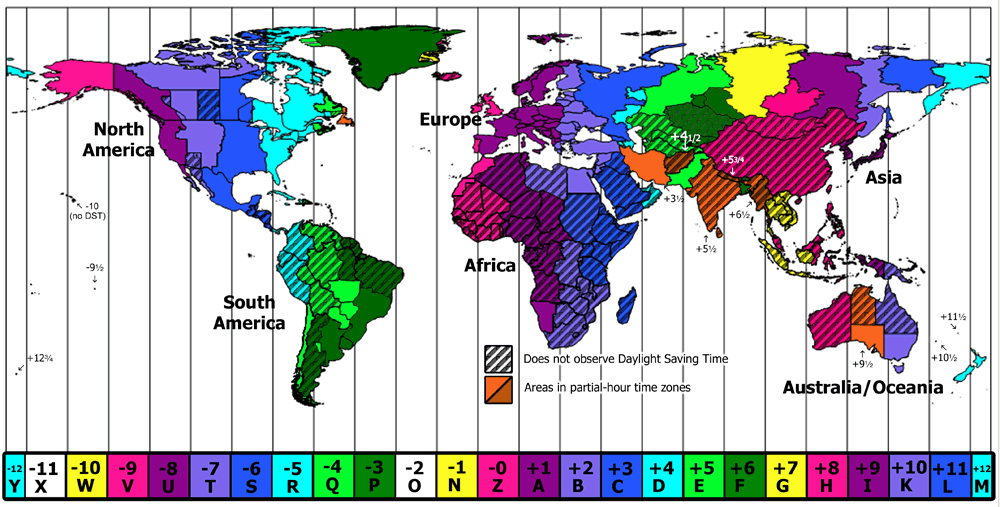
Image credit: National Institute of Standards and Technology
For example, if it’s 3:00 PM in New York, it’s 12:00 noon in California because California is three time zones to the west. If you go even farther west to Hawaii, it’s only 10:00 AM! But if you go east to London, it might already be 8:00 PM!
Who Created Time Zones?
A long time ago, before trains and telephones, people didn’t really need time zones. Every town just used the Sun to tell time. When the Sun was high in the sky, that was noon. But as people began to travel longer distances, this became a problem.
In the 1800s, when trains were invented, people could travel quickly from one town to another. But every town had its own time based on the Sun, so train schedules became very confusing. Imagine trying to catch a train when every city had a slightly different clock!
A Canadian engineer named Sir Sandford Fleming had a great idea: the world should have a system of time zones! In 1884, scientists and leaders from different countries met and agreed on the worldwide time zone system we use today.
What Is Daylight Saving Time?
Now, you might have noticed that in some places, the clocks change during certain times of the year. That’s because of Daylight Saving Time (DST)!
Daylight Saving Time is when people move their clocks forward by one hour in the spring and move them back by one hour in the fall. This helps people use more sunlight during the day instead of relying on artificial lights at night.
Why Do We Have Daylight Saving Time?
The idea behind Daylight Saving Time is to make better use of natural daylight. In the summer, the Sun rises very early and sets late in many places. By moving the clocks forward an hour, people can enjoy more daylight in the evening. This saves energy because people don’t need to turn on lights as early.
The idea was first suggested by Benjamin Franklin in the 1700s, but it wasn’t widely used until World War I and World War II to save fuel. Today, many countries use DST, but some places have stopped using it because it can be confusing and not always helpful.
Fun Time Zone and Daylight Saving Facts
- The country with the most time zones is France—it has 12 time zones because of its territories around the world!
- Some places, like India and Newfoundland (Canada), use half-hour time zones instead of whole hours!
- The International Date Line is an imaginary line where the date changes—if you cross it, you move into a different day!
- Not all places use Daylight Saving Time! Countries near the equator don’t need it because their daylight hours stay the same all year round.
Why Time Zones and Daylight Saving Time Matter
Time zones help keep everything running smoothly. Imagine if the whole world had just one time—some people would be waking up in the dark, while others would be going to bed when the Sun was shining. Thanks to time zones, everyone gets morning, afternoon, and night at the right times.
Daylight Saving Time is a little different—it helps some places save energy and enjoy more sunlight in the evening, but it’s not used everywhere. Whether you live in a place that changes its clocks or not, time zones and DST help us stay organized in our 24-hour spinning world! 🌎⏰