
Imagine you’re holding a spinning top tilted to one side. As the top spins, it always leans the same way, no matter how you move it around. Now think of Earth as that spinning top. Earth spins around an invisible line called its axis, and its axis is tilted. This tilt is what makes seasons happen!
The Tilted Earth
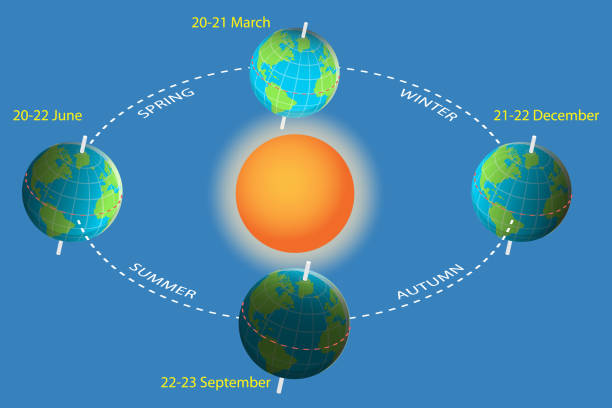
Earth’s axis is tilted at an angle of about 23.5 degrees. That means Earth doesn’t stand straight up and down as it goes around the Sun. Instead, it’s always leaning a little.
As Earth moves around the Sun in its orbit, the tilt causes different parts of the planet to get different amounts of sunlight at different times of the year. This change in sunlight is what creates spring, summer, fall, and winter.
Summer and Winter
When it’s summer where you live, your part of Earth is tilted toward the Sun. This means the Sun’s rays hit your part of the Earth more directly. It also means the Sun stays in the sky longer, giving you more hours of daylight. More sunlight and longer days make it warm, and that’s why summer is hot!
But at the same time, the other side of Earth is tilted away from the Sun. The Sun’s rays hit this part less directly, and the days are shorter. With less sunlight and less warmth, it’s winter there.
For example, when it’s summer in the United States, it’s winter in Australia. Earth’s tilt means one half of the planet gets more sunlight while the other half gets less.
Spring and Fall
Spring and fall happen between summer and winter. During these seasons, Earth isn’t tilted directly toward or away from the Sun. Instead, both halves of the planet get about the same amount of sunlight. That’s why spring and fall have milder weather. The temperatures are not too hot or too cold.
The Sun’s Angle
Let’s imagine the Sun is a flashlight. If you shine a flashlight straight onto a wall, the light is very bright and focused. But if you tilt the flashlight, the light spreads out and isn’t as strong. This is like the Sun’s rays hitting Earth. In the summer, the Sun is like a flashlight shining straight on your part of Earth. In the winter, the Sun is like a flashlight shining at an angle, so the sunlight isn’t as strong, and it feels colder.
Why the Tilt Matters
If Earth didn’t have a tilt, there would be no seasons! Every place on Earth would have the same weather all year long. The tilt is like a secret ingredient that makes each season special.
So, next time you feel the warmth of the summer Sun or watch leaves fall in autumn, remember it’s all because Earth is tilted as it dances around the Sun!